Building Production AI Agents with Gemini and ADK: What Google Cloud Next 2026 Is Really About
Google Cloud Next 2026 features dedicated tracks for Agents, Agentic AI, and Vertex AI. Here is what it looks like to actually build and operate autonomous agent systems on the stack Google is showcasing this April in Las Vegas.

Brandon Lincoln Hendricks
Autonomous AI Agent Architect
Google Cloud Next 2026 Has a Message
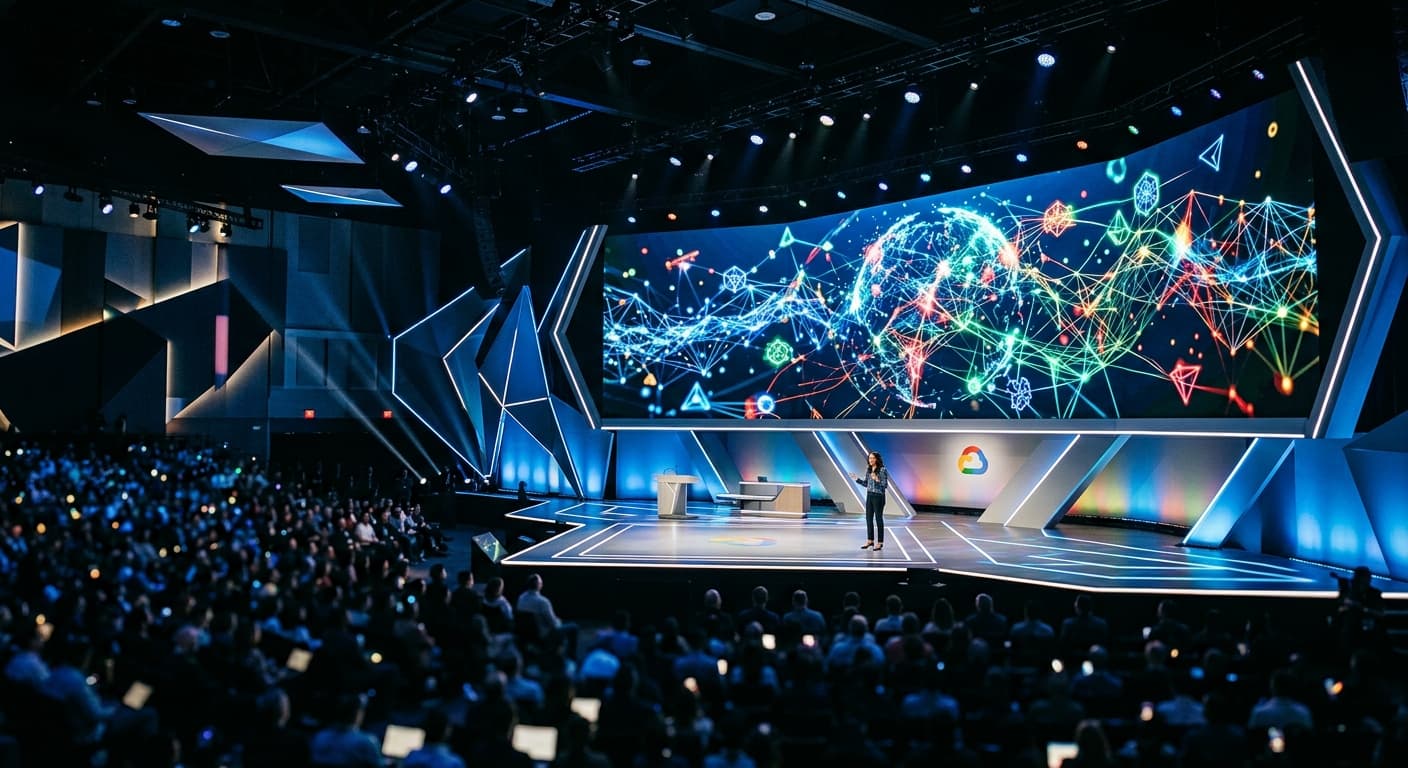
Google Cloud Next 2026 runs April 22 through 24 at Mandalay Bay in Las Vegas. Look at the session catalog and one thing is immediately clear: agents are the center of gravity this year.
For the first time, the event features dedicated topic categories for Agents, Agentic AI, Gemini, Vertex AI, and Applied AI. These are not subcategories buried inside broader tracks. They are standalone pillars of the entire event.
That tells you where Google Cloud is placing its bet. And it happens to be the exact stack I build on every day.
The Stack: Gemini + ADK + Vertex AI Agent Engine + BigQuery
Most conversations about AI agents stay abstract. Frameworks get compared on GitHub stars. Architecture diagrams get drawn on whiteboards. Conference talks show demos that never ship.
Here is what a production AI agent stack actually looks like on Google Cloud.
Gemini as the Reasoning Engine
Gemini is not a chatbot layer. In a production agent system, Gemini serves as the reasoning engine that processes signals, evaluates context, identifies patterns, and makes decisions.
When a monitoring agent observes an anomaly in operational data, Gemini reasons about whether the anomaly represents a meaningful deviation or normal variance. It evaluates the anomaly against historical patterns stored in BigQuery, considers the current operational context, and determines the appropriate response. This is not prompt engineering. This is structured reasoning within an autonomous system.
Gemini's multimodal capabilities add a dimension that most agent frameworks cannot match. An agent can process text data from APIs, analyze images from dashboards or documents, interpret structured data from databases, and reason across all of these inputs simultaneously. In practice, this means agents that can read a PDF invoice, compare it against expected values in a database, flag discrepancies, and initiate a resolution workflow without any human touching the process.
ADK as the Orchestration Framework
Google's Agent Development Kit is the layer that turns Gemini's reasoning capabilities into autonomous systems. ADK handles what most people underestimate about agent development: the operational infrastructure.
Tool registration defines what an agent can do. Memory management determines what an agent knows and remembers across interactions. Agent coordination controls how multiple agents communicate and collaborate. Workflow execution manages the sequencing and error handling of multi-step operations.
What makes ADK different from frameworks like LangChain or CrewAI is that it was designed from the start to run on Google Cloud infrastructure. There is no translation layer. ADK agents deploy directly to Vertex AI Agent Engine with native authentication, scaling, and monitoring. The gap between building an agent locally and running it in production is measured in configuration, not re-architecture.
Vertex AI Agent Engine as the Runtime
This is where most agent projects fail. Building a working agent prototype takes days. Operating that agent reliably in production takes infrastructure that most teams do not want to build themselves.
Vertex AI Agent Engine handles deployment, scaling, authentication, session management, and lifecycle operations for ADK agents. When I deploy an agent, I am not managing containers, configuring load balancers, or writing custom monitoring. The agent runs on managed infrastructure with built-in observability.
The practical impact is significant. An agent that monitors client operations runs continuously on Agent Engine. It does not require a server I manage. It does not go down when I update other systems. It scales automatically if the volume of signals increases. And every interaction is logged and auditable.
BigQuery as the Memory Layer
Every agent system needs a data backbone. In the Gemini plus ADK stack, BigQuery serves as the persistent analytical memory that agents use to contextualize decisions.
When a monitoring agent evaluates today's operational data, it queries BigQuery for historical patterns, baseline metrics, and previous agent actions. When a workflow agent executes a process, it writes the results back to BigQuery so that future decisions are informed by past outcomes.
This creates a compounding intelligence loop. The longer the system operates, the more context agents have for making better decisions. This is fundamentally different from stateless AI applications that treat every interaction as independent.
What Production Agents Actually Do
Conference demos show agents answering questions and generating content. Production agents do operational work.
Here is what autonomous agents look like in practice across service-intensive businesses.
Monitoring agents run continuously against operational data. They detect anomalies, identify trends, and flag conditions that require attention. When a monitoring agent detects that campaign performance has deviated beyond acceptable thresholds, it does not send a notification and wait. It evaluates the deviation, determines root cause, and either takes corrective action directly or initiates a workflow with a specific recommendation.
Workflow agents execute multi-step operational processes. Client intake, report generation, compliance checks, resource allocation. These are processes that currently require a human to move information between systems, make judgment calls at decision points, and track completion. Workflow agents handle the full sequence autonomously, escalating to humans only when the situation genuinely requires human judgment.
Coordination agents manage the interaction between monitoring and workflow agents. When a monitoring agent detects a condition that requires a workflow response, the coordination layer ensures the right workflow agent receives the right context and executes the right process. This is multi-agent coordination, and it is the difference between isolated automation and an integrated autonomous system.
Why ADK Over Other Frameworks
I chose ADK after evaluating LangChain, CrewAI, AutoGen, and several other frameworks. The decision came down to three factors.
Native Google Cloud integration. Every other framework requires building a deployment layer to run on cloud infrastructure. ADK deploys directly to Vertex AI Agent Engine. Authentication, scaling, monitoring, and lifecycle management are handled by the platform. This eliminates an entire category of engineering work.
Production-grade orchestration. ADK's approach to tool registration, memory management, and agent coordination was designed for systems that run continuously in production, not for demos that work in notebooks. The difference shows up in error handling, state management, and the ability to update agents without downtime.
Gemini-native reasoning. ADK is optimized for Gemini's capabilities, including multimodal reasoning, long-context processing, and structured output. While other frameworks treat the LLM as an interchangeable component, ADK leverages Gemini-specific features that improve agent performance in production.
What to Watch at Google Cloud Next 2026
Based on the session catalog, several topics at Next will directly address what production agent builders care about.
Production-ready agent architecture. Sessions covering how to move from prototype to production with agent systems. This is the hardest part of agent development and the area where most teams get stuck.
Lessons from real deployments. Google is showcasing lessons learned from over 70 agent deployments. The patterns and anti-patterns from real implementations are worth more than any theoretical framework comparison.
Agent UI patterns. Sessions on generative UI for agents, including A2UI and AG UI patterns. As agents become operational systems, the interface layer for human oversight and interaction becomes critical.
MCP integration. The Model Context Protocol is emerging as a standard for how agents connect to external tools and data sources. Vertex AI Studio's MCP integration will shape how agents access the systems they operate on.
The Architecture Gap
The most important thing happening at Google Cloud Next 2026 is not any single product announcement. It is the signal that autonomous agent systems are moving from innovation to infrastructure.
Google is not showcasing agents as a future concept. They are showcasing agents as a current operational platform with production tooling, managed infrastructure, and enterprise-grade capabilities.
For businesses running complex operations, this creates a clear decision point. You can wait for agents to become commoditized and adopt them as packaged software. Or you can architect autonomous systems now, on the stack that Google is building for, with the operational context that makes your business specific.
The businesses that architect their own agent systems gain compounding advantages. Every day the system operates, it accumulates more context, more pattern recognition, more operational intelligence. Waiting does not just delay the start date. It delays the compounding.
Going to Next
I will be at Google Cloud Next 2026 in Las Vegas. I am going specifically to see how Google is advancing the Agents, Agentic AI, and Vertex AI tracks, and to connect with other builders working on production agent systems.
If you are building on Gemini, ADK, or Vertex AI Agent Engine and want to compare notes on what works in production, reach out. The best conversations at these events happen between sessions, not during them.