Implementing Event Sourcing for AI Agent Decision Auditing in Production
Event sourcing transforms AI agent decision auditing from a compliance checkbox into a powerful capability for debugging, optimization, and continuous improvement. This guide details how to build production-grade event sourcing systems for autonomous AI agents using Google Cloud infrastructure.

Brandon Lincoln Hendricks
Autonomous AI Agent Architect
What Makes Event Sourcing Essential for Production AI Agents
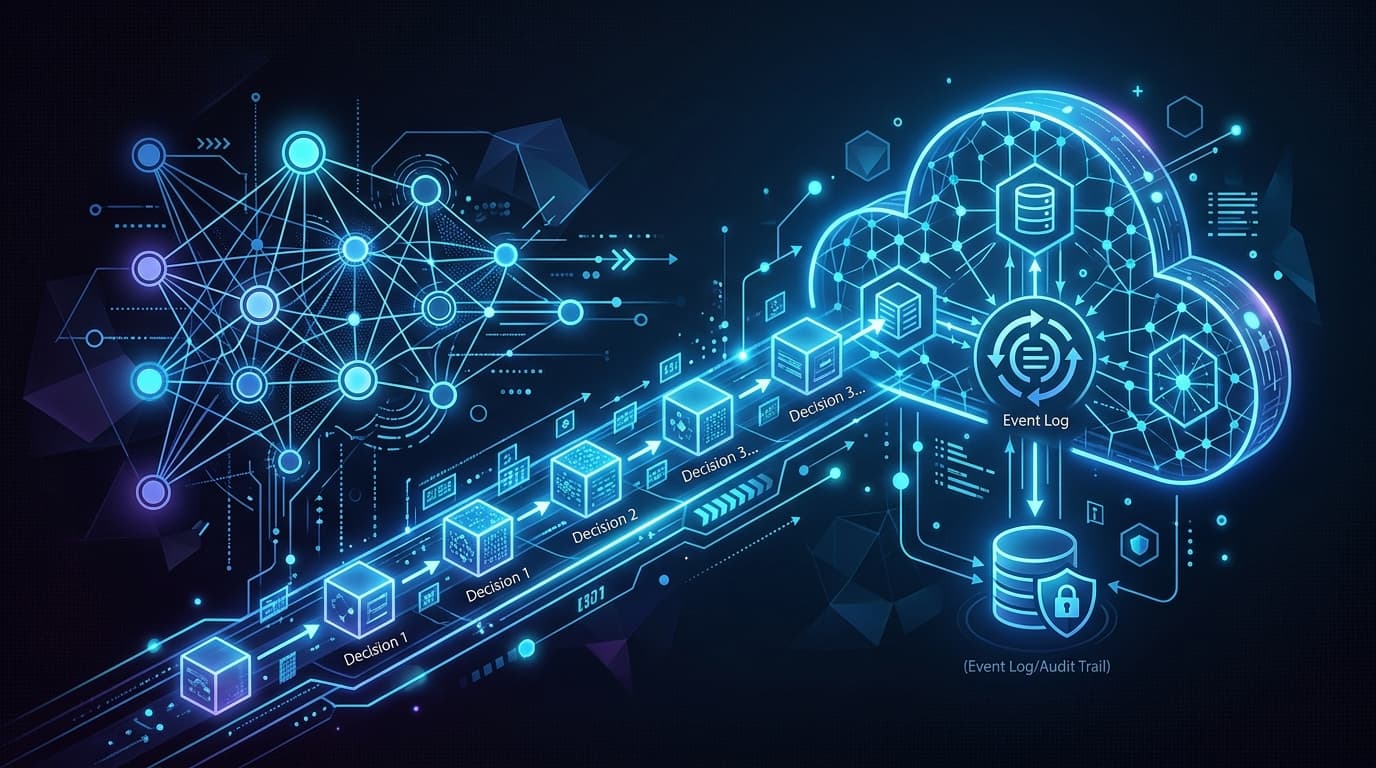
Event sourcing for AI agents is the practice of capturing every decision, action, and state change as an immutable event in a sequential log. After building autonomous agent systems that handle millions of decisions daily, I've learned that traditional logging falls catastrophically short when you need to understand why an agent made a specific decision three weeks ago at 2:47 AM.
Production AI agents operate in complex, non-deterministic environments. When a customer escalates an issue about an agent's behavior, you need more than logs. You need the complete story: what the agent saw, what it considered, why it chose a specific action, and how that decision rippled through your system.
Core Architecture for AI Agent Event Sourcing
The foundation of event sourcing for AI agents rests on three architectural principles: immutability, temporal ordering, and complete context capture. Every event represents a fact that occurred at a specific moment and cannot be changed.
In Google Cloud, this architecture leverages Pub/Sub for event ingestion, BigQuery for storage and analytics, and Cloud Functions for event processing. Here's how these components work together:
Pub/Sub acts as the event bus, receiving events from agents with guaranteed delivery and ordering within partitions. Each agent publishes to a dedicated topic or uses message attributes for routing. The key is configuring topics with adequate retention (I recommend 7 days minimum) to handle downstream processing failures.
BigQuery serves as the event store, providing both streaming ingestion and powerful analytical capabilities. Events stream directly from Pub/Sub to BigQuery using Dataflow or the native BigQuery subscription. The columnar storage and partitioning features make it possible to query billions of events efficiently.
Cloud Functions process events for real-time needs: updating materialized views, triggering alerts, or feeding monitoring dashboards. These functions subscribe to Pub/Sub topics and execute based on event patterns.
Designing Event Schemas for AI Decision Auditing
What information should an AI agent decision event contain? After iterating through dozens of schema versions across production systems, I've identified the critical fields that enable effective auditing:
Event Metadata: Every event needs a globally unique ID (I use ULIDs for sortability), timestamp with microsecond precision, event type and version, and the originating agent's identifier.
Decision Context: Capture the complete input that led to the decision. This includes the user query or trigger, relevant system state, active configuration, and any external data the agent accessed. Store this as structured JSON to maintain queryability.
Model Outputs: Record all model responses, not just the final decision. Include confidence scores, alternative options considered, reasoning traces from chain-of-thought prompting, and token usage for cost tracking.
Selected Action: Document what the agent actually did, including the specific action taken, parameters passed, expected outcomes, and any constraints that influenced the decision.
Performance Metrics: Track latency for each component, total decision time, resource usage, and any errors or retries. These metrics prove invaluable for optimization.
Here's a critical insight: make events self-contained. An event should tell the complete story without requiring joins to other data sources. Yes, this means some denormalization, but the query simplicity and debugging speed justify the storage cost.
How to Implement Asynchronous Event Publishing
Asynchronous event publishing is non-negotiable for production AI agents. Synchronous publishing adds latency to every decision and creates failure points that can halt agent operation.
The implementation pattern I use involves local buffering with overflow protection. Agents write events to a local circular buffer that a background thread flushes to Pub/Sub. This approach typically adds less than 1ms to decision latency while providing resilience against temporary network issues.
For Google Cloud implementation, use the Pub/Sub client library with batching enabled. Configure batch settings based on your latency requirements: 100ms max latency with 100 message batches works well for most agents. Enable message ordering if you need strict sequencing within an agent's events.
Handle publishing failures gracefully. If Pub/Sub is unavailable, agents should continue operating while buffering events locally. I implement exponential backoff with jitter for retries and alert if the local buffer approaches capacity. In extreme cases, older events are dropped to preserve agent operation.
Monitor publishing metrics religiously. Track publish latency, batch sizes, error rates, and buffer utilization. These metrics often provide early warning of system issues.
Building Time-Travel Debugging Capabilities
Time-travel debugging transforms how you troubleshoot AI agent issues. Instead of trying to reproduce problems, you replay the exact sequence of events that occurred in production.
The implementation starts with BigQuery's time travel feature, which provides access to historical table data for up to 7 days. But for AI agent debugging, you need more than raw data access. You need to reconstruct agent state at any point in time.
I build materialized views that aggregate events into agent state snapshots. A Cloud Function processes each event and updates these views, maintaining the current state while preserving history. This enables queries like "What was this agent's configuration at timestamp X?" or "Show all decisions made with model version Y."
For complex debugging scenarios, I've built replay tools that consume events from BigQuery and feed them through a local agent instance. This allows step-by-step debugging with breakpoints at specific events. The key is ensuring your agent code can operate in "replay mode" where it processes historical events without side effects.
Query patterns for debugging focus on correlation. When investigating an issue, I start with the problematic outcome and trace backward through correlated events. BigQuery's array functions and window operations make these temporal queries efficient even across billions of events.
Managing Event Volume and Storage Costs
Production AI agents generate staggering event volumes. A single agent making decisions every second produces 86,400 events daily. Scale to hundreds of agents, and you're looking at billions of events monthly.
Cost optimization starts with intelligent partitioning. In BigQuery, partition tables by event timestamp using daily partitions. This reduces query costs by limiting scanned data and enables efficient archival policies. I typically maintain 90 days in the hot tier before moving to long-term storage.
Event sampling provides another cost lever. Not every decision requires full fidelity recording. I implement configurable sampling where routine decisions are sampled at 1-10% while high-value or anomalous decisions are always recorded. The sampling decision itself is made by the agent based on confidence scores and decision impact.
Compression strategies vary by event type. For reasoning traces and model outputs, I've seen 70% size reductions using dictionary encoding for repeated phrases. Store large context objects in Cloud Storage with references in BigQuery for events exceeding 1MB.
Implement automated archival policies. Events older than your debugging window (typically 30-90 days) can move to Cloud Storage in Parquet format. This reduces storage costs by 90% while maintaining queryability through BigQuery external tables when needed.
Ensuring Compliance and Audit Readiness
Event sourcing transforms compliance from a burden into a built-in capability. Financial services clients particularly value the ability to demonstrate complete decision lineage for every AI agent action.
For GDPR compliance, implement data minimization in your event schemas. Personal data should be tokenized with references to your primary data stores. This enables right-to-be-forgotten requests without compromising event integrity. I maintain a deletion log that records what data was removed and when, satisfying both immutability and privacy requirements.
SOC 2 audits become straightforward when every decision has a complete audit trail. Generate automated reports showing decision distributions, performance metrics, and anomaly detection. Auditors appreciate the ability to drill into specific decisions with full context.
For financial regulations, maintain cryptographic signatures on events to prove tampering hasn't occurred. Cloud KMS integrates seamlessly for signing events at publication time. Include the signature in the event payload and verify during audit queries.
Access control requires careful design. Use BigQuery's column-level security to restrict sensitive fields while maintaining broad access to decision metrics. Implement view-based access patterns where different roles see different projections of the same events.
Real-World Performance Metrics and Optimizations
After implementing event sourcing across multiple production systems, I can share concrete performance benchmarks. A properly configured system handles 50,000 events per second with sub-100ms end-to-end latency from agent decision to queryable in BigQuery.
Pub/Sub publishing latency averages 5-10ms with proper batching. Avoid the temptation to disable batching for "real-time" needs. The latency reduction rarely justifies the 10x increase in API calls and costs.
BigQuery streaming inserts add 2-5 seconds before data becomes queryable. For real-time dashboards, I maintain dual paths: events flow to both BigQuery and a Memorystore Redis instance. Dashboards read from Redis for current data and BigQuery for historical analysis.
Query performance depends heavily on schema design and partitioning strategy. Queries scanning a single day's partition return in under 2 seconds for tables with billions of rows. Cross-partition queries benefit from clustering on agent_id and event_type fields.
Storage costs run approximately $20 per million events in BigQuery active storage. After 90 days, long-term storage reduces this to $2 per million. At scale, event sourcing adds $5,000-10,000 monthly to infrastructure costs for systems processing 100 million decisions.
Integrating with Agent Observability Platforms
Event sourcing forms the foundation for comprehensive agent observability. Beyond debugging, these events power real-time monitoring, performance optimization, and predictive maintenance.
I build custom dashboards in Looker Studio that consume BigQuery data directly. Key metrics include decision latency percentiles, confidence score distributions, error rates by decision type, and token usage trends. These dashboards update hourly using scheduled queries.
For real-time alerting, Cloud Functions process events and evaluate alert conditions. Alert on anomalies like sudden confidence drops, unusual decision patterns, or latency spikes. Route alerts through Cloud Monitoring for integration with existing incident response.
The event stream enables sophisticated analyses. Train models to predict agent failures before they occur. Identify decision patterns that correlate with poor outcomes. Optimize prompts based on historical performance data.
Integration with APM tools like Cloud Trace provides end-to-end visibility. Include trace IDs in events to correlate AI decisions with downstream system behavior. This proves invaluable when debugging complex interactions between agents and traditional services.
Conclusion: Event Sourcing as Competitive Advantage
Implementing event sourcing for AI agents requires upfront investment in architecture and infrastructure. But the payoff comes quickly. Debugging time drops from hours to minutes. Compliance becomes automated. Performance optimization shifts from guesswork to data-driven iteration.
The teams I work with consistently report that event sourcing transforms their relationship with production AI systems. Instead of dreading the question "Why did the agent do that?", they confidently query the event store and provide definitive answers.
As AI agents handle increasingly critical business decisions, the ability to audit, debug, and optimize their behavior becomes a competitive advantage. Event sourcing provides the foundation for this capability, turning the black box of AI decision-making into a transparent, auditable, and continuously improving system.